Aaaargh. It was 3.15pm on a Monday. I was a Principal Advisor at a large Crown entity, and was standing over a photocopier to make sure it didn’t run out of paper while printing a 100-page document.
Although the report was important, with a deadline set by legislation, and I’m not against ‘getting my hands dirty’, I was fuming. There was another deadline also looming and I wanted to be back at my desk doing the thinking for that.
This situation – feeling frustrated by admin or other tasks that drain you when you want and need to be doing the other work in your role through which you can provide better value – is one that happens across the public sector and one I hear a lot. Especially in these times when budget allowances are often no longer made for team administration roles.
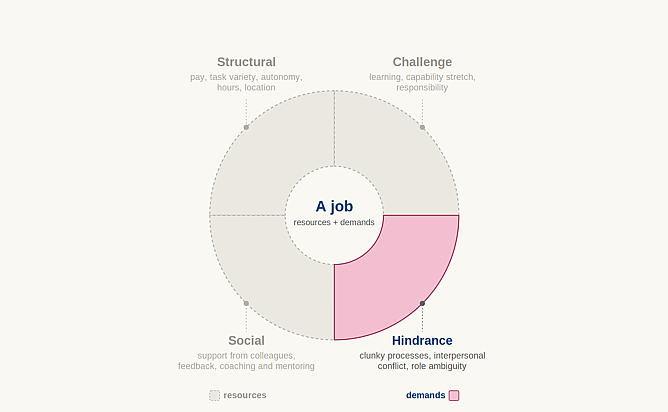
So, this fourth and last post in my job crafting mini-series focuses on the job crafting dimension of dealing with hindrance demands. The earlier posts in the series covered:
the basics of job crafting, why you might job craft and what it can bring you in your work and career
the first and second job crafting dimensions of increasing your structural and social resources, and
the third job crafting dimension of increasing the challenge in your job – the key dimension for career development.
Let’s get stuck in.
So what are hindrance demands?
In short, hindrance demands are the demands of your job which bring an ongoing or repeated ‘cost’ – whether it’s physical, mental or emotional – but which, unlike challenge demands, don’t build you up.
Hindrance demands tend to feel like they’re wasting time, obstruct progress, and lead to feeling irritated, depleted, and demotivated, unlike challenge demands, which bring knowledge-expanding learning, the satisfaction of attaining a goal that you had to stretch for, or growth in your career. Minimising hindrance demands in our work is part of the ideal equation of job demands and resources that we need to aim for, for maximum engagement, satisfaction and career development.
But while hindrance demands, which are also referred to in the research literature as hindrance stressors, can be dealt with using job crafting, there are a couple of caveats to note.
Caveat 1: distinguish the hindrance demands you can fix from those you can’t
My advice to you from a career coaching perspective, is that you need to work out which hindrance stressors you actually have influence over. In this way, you won’t look in the wrong places for job crafting opportunities or try to change something that you just can’t.
A 2023 paper, authored by Dr Geoff Plimmer from Victoria University of Wellington’s School of Management, and his colleagues, note that hindrance stressors are often outside employees’ control. The study of New Zealand public servants he and his colleagues undertook looked at role ambiguity, job insecurity, unclear organisational goals, resource constraints and interagency collaboration, precisely because they were deemed to be beyond the influence of employees.
Bakker and Demerouti (2024), on the other hand, provide examples of hindrance demands/stressors that are within the sphere of influence of employees. For example, overly complex work issues, administrative hassles, interpersonal conflict, and email overload. They’re still things that obstruct your progress and drain your energy, but you have much more influence over them. So it’s toward these sorts of hindrance stressors that you should direct your job crafting energies.
Caveat 2: fewer hindrance demands won’t lead to feeling more engaged
Before you get stuck into crafting those hindrance demands out of your working life, this second caveat is an important one to know too.
Decreasing or even eliminating hindrance demands might decrease the stress that comes from them, so it can be a useful thing to do for your wellbeing at work, but it won’t lead to feeling more engaged. If you imagine a scale with the negative values on the left and positives on the right, decreasing hindrance demands might get you out of the negatives and back to zero, but you need an injection of something actively positive to get you to the right side of the scale and feeling happier and more engaged at work.
Terhi Susanna Nissinen et al. (2022) found from their study of Finnish public servants that increasing your structural resources at work – particularly more learning opportunities – was the best way to increase work engagement. Importantly, they also found a negative association between work engagement and decreasing hindrance demands. That means, no positive link was found between getting rid of the more stressful aspects of your job, and feeling more engaged. They noted earlier research by Petrou et al. (2012) which suggested this might be because decreasing hindering demands at work might result in having less motivation.
But Nissinen et al. did find a negative association between decreasing hindrance demands and workaholism, which is good to know. Put another way, you’re less likely to overwork with fewer negative stressors in your job.
So, with these two caveats in mind, we’ll move on to how you actually go about decreasing the hindrance demands in your job.

What does decreasing hindrance demands look like in practice?
Let’s go back to the photocopier and see what I did next.
Realising that I wouldn’t actually know what to do if there was any issue with the copy machine, I decided to enlist some help from a team I knew who regularly made bound hard copies of documents for Parliament.
I walked up the stairs, found my equivalent in the other team, and introduced myself. She understood the situation and its gravity instantly, and dropped what she was doing to take over supervising the copier, allowing me to run back to my desk for 20 or so minutes. When I went back upstairs, the copying was nearly done and we worked together to bind the documents. She recruited another of her team, who knew where to go, to deliver them to Parliament.
Finding a way to cut down my time on an unfamiliar and stressful task to just half an hour meant that I felt calmer, could direct my attention back to the other work that needed my attention, and meant I didn’t feel spread so thin. Suffice to say, it removed a source of stress. And, through the process, I also made a new contact and friend in another team, which led to me having an understanding of the work they did. So it was a win for my social and structural resources at work as well.
Some coaching questions to get you started
If we were having a coaching conversation about how you could decrease your hindrance demands at work, these are the sort of questions I might ask you:
What’s the task you have to do each week which costs energy, time and doesn’t bring learning or growth, and what would you prefer to be focusing on?
What’s stopped you changing or removing such a draining task previously – habit, an unquestioned rule, a belief you just need to ‘handle’ it?
Who could you talk to today to test if those assumptions are correct?
Getting help with implementing your grand job crafting plans
Has this post has got you thinking that you might have some things you could do differently in your role? If you know what to start with, just not how to make it happen, the first step is talking to your manager, a Principal or Chief Advisor, or any trusted colleague about your ideas. Job crafting is a process that involves behaviour change, and as with all behaviour change, it helps to have support and cheerleaders around us, and people to whom we have to stay accountable.
Alternatively, a career coach can help. They don’t only work with people to help them completely change jobs and careers, because enhancing your career is also about looking for and exploiting opportunities for growth within your current role and organisation.