What is job crafting? Why might someone want to craft their job? Can you do job crafting?
These are all good questions, and together, they provide the structure for my blog post this week. It’s a topic I’m really into, because it’s a way that you can take charge of your work and progress your career, without actually leaving your current job.
You may not be as excited about your role as you were when you first started, but that doesn’t mean you’re willing or able to just change jobs, especially with uncertainty over jobs and public sector head counts still hovering over the sector like a dark storm cloud.
What is job crafting?
Job crafting is a term that was coined by Amy Wrzesniewski and Jane E. Dutton, two American academic researchers, in 2001. It’s when an individual employee redesigns their current role to make it fit with their task preferences and working style, with what they’re good at or skills they’d like to develop, with their professional identity, their values or purpose.
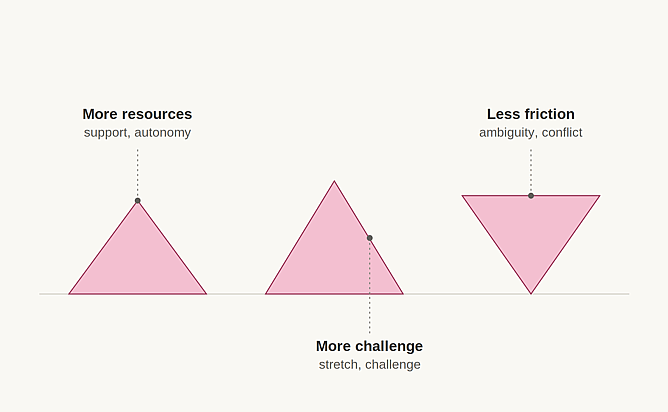
In 2010, researchers Maria Tims and Arnold Bakker (from Erasmus University Rotterdam) developed their job crafting framework with three parts: redesigning your job by
Increasing the level of job resources available to you at work (e.g. social support)
Increasing the level of job demands in your role (e.g. tasks with ‘good’ challenge)
Decreasing the level of job demands (e.g. process roadblocks).
At this stage, these job crafting components might seem unclear, but I’m going to explain each of them in turn over the next three blog posts, as part of a four-part series. So for now, let’s talk about what drives job crafting.
Sound familiar?
Feeling unmotivated, or bored? What about stressed, or overwhelmed, or drained from constantly pushing rocks uphill? Or, like you’re maybe starting to ‘sign out’? These feelings are normal and could indicate you have a person-job misfit.
When we have good person-job fit, the resources our organisation affords us or that we personally bring to our job (job resources), and the physical, emotional, social or organisational efforts we have to make to complete our job (job demands) are in balance. Works feels good. When these job demands and job resources aren’t aligned, you’ll feel the gap between the two.
Each of these feelings though can stem from one or more pieces of the work puzzle, when an element that isn’t strong enough, or is missing entirely. For example, you could feel bored or unmotivated if there is too much repetition in the tasks you do, or if you’re not clear on the purpose or mission of your team or organisation. In the case of feeling stressed, this could be because the tasks you’re required to do are, currently, just beyond what you’re confidently capable of. Or it could be because you don’t feel you’re getting adequate support from your supervisor and/or colleagues.
You could also feel a person-job misfit when you've outgrown your job, when the challenge has gone. This is when we start considering our options and try to add challenge and responsibility by getting promoted. It’s something I discuss in my previous blog post, because progressing in your career in the public sector using the mechanism of promotion isn’t as straightforward as it used to be.

Can anyone job craft?
The short answer: yes. The longer answer: some personal characteristics and features of your work environment make it more or less likely you'll give it go, and more or less easy to get underway. If you don’t see yourself or your work situation in the five points below, it doesn’t mean you can’t job craft, you just might feel more friction and might need to be a more determined job crafter.
Proactive personality: Having a proactive personality was identified by Tims, Bakker and Derks (2012) as making you more likely to have a go at job crafting, because you’re willing to take the initiative to make your work better fit your personal preferences.
Self-efficacy: Having the confidence and belief in your ability to succeed plays a similar role to having a proactive personality, Tims, Bakker and Derks also noted. If, however, you’re not feeling that confidence, you can still try job crafting, but having some extra support and encouragement (borrowed confidence!) will help.
Empowering leadership: Having a supportive manager or leader who empowers their team was found by Audenaert et al. (2020) in their study of nurses in Belgium to enable job crafting empowering leadership transfers power and autonomy from the leader to the employee.
Social support: Audenaert et al. also found that social support paves the way for job crafting. It’s because having good relations between you and your colleagues, and your supervisor, can boost your confidence to try new things and the support to make them happen.
Task independence: Lastly, job crafting is easiest when the tasks you do at work aren't intertwined with those of your colleagues. It’s called ‘task independence’. If doing your work is heavily reliant on the work of others, or others rely on your doing your work in a certain way by a certain time, it won’t be impossible to craft your role, but it might be more difficult.
So, how do I start job crafting?
No matter where you landed on each of the characteristics and features above, job crafting is an option. Because they aren’t indicators of whether you’ll be successful, just how likely you are to get out of the starting block.
If the cogs in your brain are starting to turn about this job crafting and that it could be something you’d like to try, I’m going to cover each of Tims and Bakker’s dimensions of job crafting in my next three blog posts, so stay tuned for those!
But if you have a burning question that just can’t wait, I’d love to hear from you and get you the information you need. Just send me an email at marie-louise@fireflycoaching.nz or DM me on LinkedIn at https://www.linkedin.com/in/marie-louise-siddle/.