Hi again. I’m back today with the third of four posts in my mini-series on job crafting. Glad you’re here!
In the first post in the series, I outlined what job crafting is [link], why you might choose to job craft, how to do it and what it can bring you in your job and career. The second post went down into the detail of the ‘increasing resources’ dimension of job crafting, that is, the ‘structural’ and social resources you have at your disposal at work to help you meet the demands of your job. Things like the support of colleagues, autonomy to organise your work, and having a variety in the tasks you do and skills you use.
Today in post #3, we’re going to talk about the ‘increasing job demands’ job crafting dimension. Now, I’ll admit that that doesn’t sound like something you’re going to want to do when you’re already busy enough. But bear with me.
‘Increasing job demands’ is the second dimension of job crafting, in the model of researchers Maria Tims and Arnold Bakker (2010), and as a career coach, I think it’s the one that can help you most to expand your knowledge, stretch your capability, and grow your career.
Developing your career is important to most women, and lack of career progression was given by New Zealand public servants as the top reason by those who said in a survey that they intended to leave their public service jobs (New Zealand Public Service Census, 2025). But with so many public sector job cuts, and promotion rounds missing in action due to organisational restructuring, it can be hard to keep growing.
Job crafting is ideal in that scenario. It allows you to redesign your job to have more learning, more challenge, more responsibility – whatever it is that is important to you – right in the job you’re already in. So let’s get into the detail.
What are ‘job demands’? There are two types
Job demands, or the demands of your job, are the things that your job asks of you in terms of mental and physical investment, but they're also what your job puts in front of you, whether it’s a knotty problem that's kind of fun to resolve, or a time-wasting and unnecessarily bureaucratic process that should have been got rid of years ago. Tims and Bakker (2010) write that job demands are one of the two sets of working conditions that determine employee effectiveness and wellbeing (with the other being job resources).
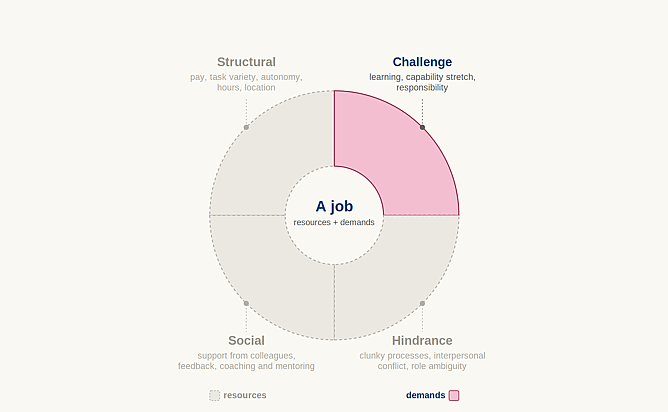
Just like with job resources (which can be broken into structural and social), job demands also come in two flavours.
Hindrance demands (sometimes called hindrance stressors) are what they sound like: aspects of your job that hinder you, that get in your way or at least put the brakes on your forward momentum, and that will result in you feeling strained in your job if you can’t marshal sufficient job resources to combat them. They’re things like having to deal with difficult customers or stakeholders, having social interactions at work which trigger you emotionally, a high workload or time pressure, office or organisational politics, role ambiguity or time-consuming processes. Stress experienced at work is often because of these hindrance demands.
Challenge demands (otherwise known as challenge stressors), however, are a good type of job demand. You want to have challenge demands in your job! They’re tasks or side projects that help you use all your skills at work, projects that seek to solve a particularly interesting problem or design a solution to an important issue, and duties that add responsibility to your role.
We’re going to talk more about challenge demands now, and will cover off what to do about hindrance demands in the next post (the fourth and last of the 4-part job crafting mini-series).
Why are challenge demands good for our work and career development?
As immediate outcomes, challenge demands drive up your motivation, give you a sense of attainment when you solve a trick technical or interpersonal problem, and help you feel more engaged, achieve job satisfaction or move you towards goals you have for your career by expanding your capabilities.
These work outcomes in turn have been found to increase how long we can stay working in our job, or our “work sustainability” (van den Heuvel et al., 2017). They've also been found to decrease our desire to leave (that is, our “turnover intention”). So, from a manager’s or organisation’s perspective, this facet of job crafting is pretty beneficial too.
What adding a challenge demand looks like in practice
There are lots of different ways that you can add more good challenge to your job demands at work. You could:
volunteer to join a project which will give you opportunities to apply your knowledge and skills in new ways
take on some extra people-related responsibility, such as offering to mentor a more junior member of staff, or offering to your manager to be the person who always inducts and supports new staff members
step up to lead a project that’s on the horizon for your team, if that’s something you haven’t done before and you’d like to have more influence over how projects are carried out.
A colleague I had in a Crown entity a few years ago was a senior advisor, but with lots of prior work experience and relevant postgraduate qualifications, and she wanted to progress to working at the level of principal advisor. So, when a member of the team suddenly resigned to take up a job elsewhere, an opportunity to lead on the organisational quarterly reporting opened up. My colleague put her hand up immediately, even though it was new territory and not without stress, because it would give her the chance to lead on a piece of work and have more autonomy. After the change, her work felt better because it was more aligned to her professional identity as someone who can take charge and steer the direction of projects, and it gave her the opportunity to prove her project leadership capability.

Career coaching questions to help you add more challenge to your role
Here are some coaching questions to help you get clear on what type of challenge you’re after and where you could find it.
What does your ideal professional identity look like 3-6 months from now? What type of tasks make up the work of someone with that professional identity?
When you look at the business plan for your business group or organisation, what upcoming projects will your team, or perhaps an adjacent team, need to complete? Do any of them pique your interest?
When you think about how your team does things, what tasks or processes take longer than they should? Could you research and propose a new approach, as a side project?
Need help?
Job crafting may be new to you, and although I’ve explained how part of it works here, you may not be sure how it would or could look in your particular job and work situation. Which makes complete sense.
If you think career coaching might help you get clear on how to design more challenge into your job, I’m here to help. Don’t hesitate to drop me a DM on LinkedIn https://www.linkedin.com/in/marie-louise-siddle/ or an email marie-louise@fireflycoaching.nz.