And we’re back! This week’s blog post is the second in a 4-part mini-series on the process of job crafting – what it is, what it can do for you in your work and career in the public sector, and how you actually do it.
In last week’s post, I outlined the job crafting process as a whole. That’s how you can redesign your job yourself in smaller or more radical ways to make it fit better with your work goals and preferences, and to stretch you in ways that also develop your career without you having to completely change jobs.
I also outlined the three dimensions of job crafting according to the model put forward by researchers Maria Tims and Arnold Bakker in 2010:
increasing job resources to help you meet the demands of your job
increasing the level of (good) challenge inherent in those job demands, and
decreasing the level of demands in your job that are of the bad or ‘hindering’ type.
In this post, we’re going to break down and go deep on increasing job resources, what will bring you more of them, and the effect they have.
What are job resources?
‘Job resources’ is an academic term, and Tims and Bakker (2010) explain that it means all the things and people that come with your job, or that you bring to your job yourself, that enable you to complete the tasks of your job, counteract the physical or psychological ‘costs’ of your job, and stimulate and facilitate your personal growth at work.
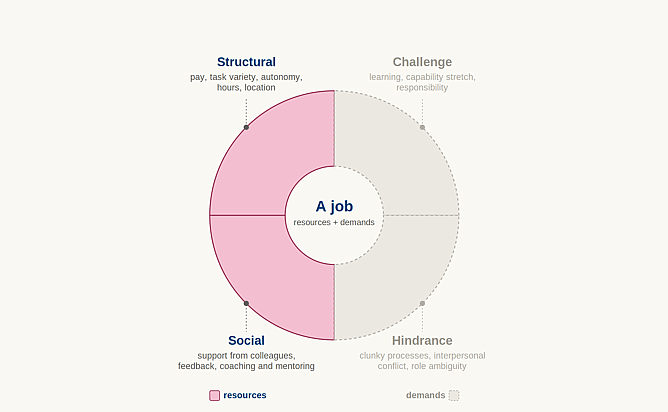
Tims, Bakker and Derks (2012) split job resources into two categories: structural and social. So let’s talk about each of these in turn.
Structural resources – the concrete things that determine what a job looks like
Structural resources include things like pay, job security, professional development opportunities, status, task variety and autonomy, as well as practical things like work hours and location.
For me, in simple terms, structural resources are what make the job you do, the job you do. It’s the sort of detail we look for in a job ad or in the lists of a role description. And structural resources are important, because research has found they’re the main route to engagement at work (Xanthopoulou et al., 2009) and finding meaning in your job (Petrou et al., 2017).
But as we know, through the process of job crafting, we can increase the structural resources at our disposal. Which is great, because there are certain structural settings of our jobs that we can leverage to learn and develop our capability, like changing the type and variety of tasks we do. Professional development and career growth can also hide in less obvious structural settings, like changing where we work, and therefore, who we work alongside.
A very simple kind of job crafting via increasing your structural resources is to try working out of another of your organisation’s work locations, if they have more than one in your city. It takes advantage of a structural resource that’s already provided, to increase other structural resources, like professional learning opportunities. And with many public organisations in the New Zealand public sector having adopted hot-desking, it makes this much easier.
A manager of mine in a large Crown entity I used to work at did this once for several weeks and found it really energising. It expanded her understanding of work underway across the organisation, gave her the opportunity to learn about a different professional discipline, and helped her see her own work area from a different point of view.

Social resources – the relational aspects of your job that shape how a job feels
Social resources at work, on the other hand, are things like feedback from your manager and other colleagues, the support your get from colleagues and leaders, the team climate and social activity, the other social interactions you have as part of your job (and who you’re interacting with), any networks you’re part of, and coaching and mentoring.
For me, again reduced down to the essence, social resources make the difference in how a job feels to work in it day-to-day. Social resources are the positive feelings of affiliation and belonging, affirmation of our professional identity, and helpful technical guidance you get from people at work. Tims et al. (2013) found that increasing social resources didn’t just lead to engagement at work, but also to job satisfaction, and that it was negatively associated with (led away from) burnout.
One of the key benefits of increasing our social resources at work is that they help us to stay energised, and to have energy left over for keeping one eye on the ‘bigger picture’ of developing and progressing our career.
There are lots of different ways that we can bolster the social resources we can call on in our job. Although sometimes it can be hard to get support and feedback from your manager, especially when they are experiencing pressure from all sides too, it’s worthwhile to make sure you have at least a half hour 1:1 with them every week. Or, if you do that already, why not try and reorient the meetings so they net you more value?
Gaining more support from colleagues is usually easier, and simple measures like setting a recurring meeting for your team or business group to do a quiz together are underrated. Even when not everyone can make it every week, this can play to your advantage: it’s gives you opportunities to talk to, share a laugh with, and get to know a member of staff you don’t often work alongside. They might turn out to be the next must-have addition to your personal support network.
An example from my own career was when I opted to join a project team working on a large report so that I’d be able to work with the external contractor who was the project lead. For a 6-month period, I got regular feedback on my work from an outsider’s perspective, and general moral support, at a time when my organisation was struggling with a number of challenges and my own manager was new in their role and overloaded.
In fact, as a side note, job crafting was found by researcher Evangelia Demerouti and her team (2020) to be instrumental in helping employees proactively navigate and make the most of organisational change. Super relevant for the New Zealand public sector in the current era.
So, now we’ve been through what increasing structural resources means on the one hand, and what increasing social resources means on the other. You can use that knowledge to start crafting your job, to make it more what you need it to be right now and to get the growth to progress your career. But how do you transfer that knowledge into action?
Try this: how to start increasing resources to meet your job demands this week
Crafting your job to leverage more resources to help you tackle its various demands needn’t be a huge undertaking.
You can start learning how to job craft by answering these simple coaching questions. They’re the sort of questions I would ask you if we had a coaching session together.
Increasing your structural resources
Do you like the mix of tasks in your role? If not, how would you like the mix of tasks to look different?
If you could redesign one part of your week – when, where, how… - what would you change first? What is the first, smallest step you could take to do that?
Increasing your social resources
Can you think of one way to draw more support from colleagues or your manager than you currently do?
Is there someone you know – well, or perhaps only a bit – that you think might be a good mentor for you?
You’re done! You’ve learnt the first dimension of job crafting
How did you find that? Could you answer the questions? Are you starting to have an idea where to start with your crafting? Let me know if you have any questions. You can email me at marie-louise@fireflycoaching.nz.
In my next post, the third in my 4-part mini-series about job crafting, I’ll focus on the ‘increasing job demands’ dimension of job crafting. On the face of it, I admit that sounds like something you won’t want to do. But, one side of the job demands coin is about seeking more challenge in your current role – and that’s exciting, because it leads to you growing in your career!
If you’d like to receive a link to the post in your inbox, sign up to my fortnightly newsletter using the form below. You’ll get added to the list automatically so you don’t miss any of the job crafting posts.