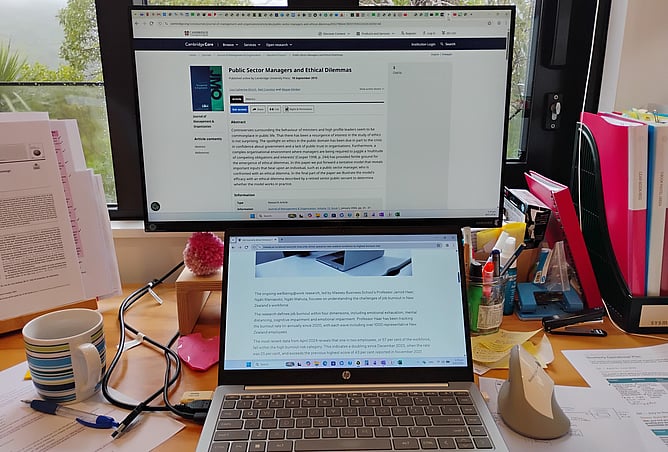
Five months after I started, excited at what could be a great role for me with leaders I got on well with, my manager resigned and left. It was the first of multiple resignations in my team, due to uncertainty about what would happen in the restructure.
It didn't end up sinking, as it happens, the team or the organisation, but staff had to sit with low-level, always-there uncertainty for about nine months as a result of the 'reshaping'.
What I've come to realise is that this kind of job insecurity is one of a number of hidden stressors public sector professionals experience. They're sources of stress which aren't always obvious or tangible, and they might not even seem enough of a big deal to cause you stress. But they're there, nevertheless, taking a little shine off your experience of work, compounding over time to have real negative effects. On your feeling of engagement with your job, on your overall job satisfaction, and on your health.
So, in this post, I want to 'surface' five of the hidden stressors for people working in the public sector you might be experiencing right now, but perhaps haven't been able to name.
Workplace stress in the public sector - visible vs invisible
There are lots of different drivers of stress when you're working the public sector.
Some work stressors are more obvious than others. Workload is one - what's called quantitative demand by some researchers. Bullying and harassment is another - unfortunately something that has become fairly common, and which many of us (including me) have experienced first-hand. Racism and discrimination too are unfortunately still being raised as an issue. For example, in the 2025 Public Service Census, 14.4% of respondents overall said that they had experienced some form of discrimination.
The less obvious stressors, together, make up what work feels like and can be hard to tease apart to identify individually. They're sort of nebulous, and, not often discussed. The first is one I had experienced often, in all of my public sector roles, but only discovered the name of when I was taking my final Master of Public Management paper.
Emotional labour, or hiding your emotions
Nobody puts 'emotional labour' as one of the key responsibilities in your role description, but it's an everyday part of work in the public sector.
Sociologist Arlie Russell Hochschild, who pioneered the term, defined it as the managing of your own emotions so you can present a more acceptable emotion to those you work with or for. Think of cabin attendants on a long-haul flight as an example.
Similarly, public sector employees need to manage their own emotions (including pushing down their own true but negative feelings) to show up to others in their workplace with the right 'face'. For front-line workers, that's going to be swallowing their own feelings to seem approachable and helpful to members of the public - at the A&E reception desk, the information counter at the library, or the Work and Income office. For those in the 'back office', it's more about maintaining an outward 'can do' attitude and air of cooperation with colleagues, especially managers.
You may be fortunate to have a trusted colleague or line manager with whom you can be candid about what happens in the course of your work days. But often times, going along with things for the 'greater good' is Situation Normal, and can become a low-level but chronic stressor. It's why the occasional vent or rant away from the office can feel so good.

When you're missing psychological safety at work
Have you ever been in a meeting and wanted to say something that countered the view of the dominant speaker in the room, then decided against it? You probably did some mental to-ing and fro-ing. Should I? But if I do, then… After this internal cost-benefit analysis you decide that the possible gain is not worth the potential damage to an already tenuous relationship, your reputation in the eyes of that person (and maybe others), or even your career prospects.
This is an absence of 'psychological safety' at work. It's a term that has become somewhat of a catchphrase to mean being mental safe from harm in the workplace.
A more nuanced definition of psychological safety (see the research and books of Harvard's Amy Edmondson) is when your workplace has a culture in which team members feel comfortable to speak up with ideas or to raise issues, to publicly take risks, and to try things out for continuous improvement or to innovate.
When there isn't psychological safety in your team or workplace, you withdraw or withhold some of your intellectual or emotional investment in your work and the work of the organisation. That is, you're not fully engaged. That's OK for a while, but over a longer period of time - even if you're on an awesome salary - it feels constraining, wearing, disappointing.
Serving all your stakeholders and the toll that takes
Once when I was in a strategy, planning and performance role, I brainstormed a list of all the other government organisations that were our stakeholders and/or monitor agencies. I counted nine, and had to correct my list when someone pointed out that I'd missed some. And that was just within government.
Australian researchers Kimber, Ehrich and Maddox (2004) argue that public sector managers have to weigh the views of many more stakeholders in their work than in the past: clients and suppliers, communities, individual 'customers', as well as Ministers and the Government of the day, and other public sector agencies.
On a day-to-day basis, this complexity can manifest for individual public sector workers in uncertainty about how to treat an Official Information request, hesitancy in drafting policy briefings because the wording needs to be 'bullet-proof', and having to run things past Legal, so as not to 'put a foot wrong' in a media release. It not only adds time and work, but also an unpleasant fear that you could unwittingly breach someone's rights or fair expectations.
When work goes home with you - work privacy conflict
Bringing work home with you can be physical, mental or emotional. You might have to find 45 minutes after dinner to open your laptop and finish a slide deck, or 10 minutes to reply to an "Urgent" email. Or you might just be ruminating over something that happened in the office, or how that awkward conversation with your manager is going to go tomorrow.
However work goes home with you, 'work privacy conflict' was found by Lincke et al. (2021) to be the psycho-social workplace factor that was most strongly related to burnout risk. More than job insecurity, unfair treatment or having too big a workload.
And for people who might be juggling work and caring responsibilities, whether that's children or perhaps elderly parents, the blurring can become even worse with the need to switch flexibly between roles as schedules allow.
I've certainly been known to take "quick calls" while walking down to the school gate, or to check work emails on my phone while my child was playing at the park. Looking back, I let work leak into my precious between-role transition moments and times when I should have been able to just 'be'. I was trading opportunities for rest and recovery for more open loops and stress when my work day was supposed to be finished.
The uncertainty that never goes away - job insecurity
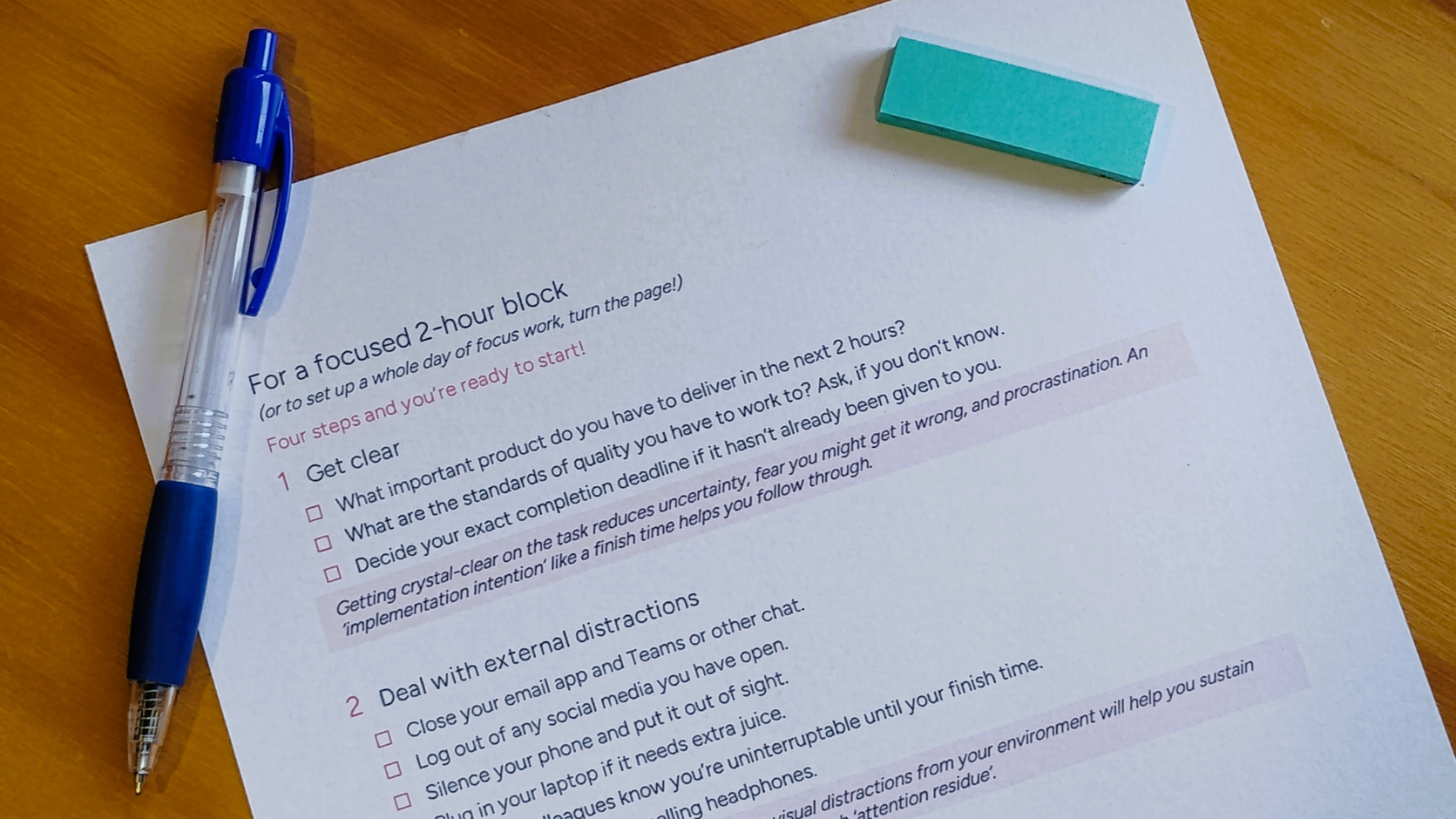
On top of all the other drivers of stress in the public sector is an almost existential one - whether or not you'll keep your job. In some moments, we might flippantly think 'Good riddance!', but then reality bites: How will we pay the mortgage? Pay for that trip to visit family who live overseas? Pay the school 'donation'?
AUT's Professor Jarrod Haar found in research on burnout risk in New Zealand workplaces that 48% of people surveyed feared their job was at risk, and that this perception was driving a significant increase in burnout risk amongst New Zealand employees - to one in two employees being at high risk of burnout as at April 2024.
With the sweeping cuts across the New Zealand public sector in the two years following, and with more cuts announced to occur in the next three years, it's possible that statistic is even worse now.
It's not surprising. Work is where we express and build our identity, find purpose, and connect with like-minded people. The salary is almost secondary to these other crucial things we stand to lose.
It's not necessarily an acute feeling, but it's background noise that has become ever-present.
Hidden workplace stressors – what can you do?
Many of these stressors aren't things that you can fix on your own. They're structural and systemic – woven into how the public sector is organised.
But naming them makes a difference. As Emily and Amelia Nagoski argue in their book Burnout, even if you can't deal with the stressor, you can complete your stress cycle and deal with the stress. Identifying exactly why you’re carrying the stress you’re carrying, validates how you’re feeling.
If you’re processing these ideas and they’re resonating, let that sink in. Your work stress has a number of structural origins. You don’t need fixing.
And if you’d like to work on practical strategies to manage these pressures – and build your defences against the stressors you can’t control – I coach women in the public sector to do just that.
_________
Hi, I'm Marie-Louise. I help women in the public sector make more progress in their work, with less stress and avoiding burnout, so that they can feel more satisfied and positive at the end of the day.
I write this weekly-ish blog, to share the helpful action-oriented gems from the research evidence I find in my reading. I've just launched a new 1:1 online coaching offering focusing on tackling your work overwhelm, and offer personalised coaching too. Get in touch, I’d love to hear from you. I'm at marie-louise@fireflycoaching.nz or www.linkedin.com/in/marie-louise-siddle on LinkedIn.