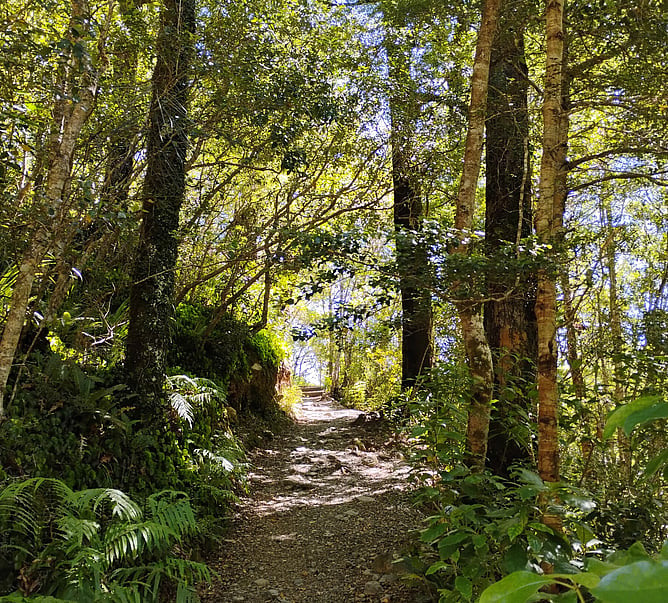
I have always walked - as an adult, anyway. I live in Wellington, New Zealand, which may not seem an ideal walking location. It is as hilly as it is windy. But I walk almost every day, even multiple times some days. I do express walks at lunchtime to clear brain fog after hours of staring at a monitor. I walk to the school gate for the afternoon pick-up. I walk with friends on weekend mornings for exercise and a good, solid chat.
I mostly walk through built environments, on asphalted footpaths, past houses of timber and corrugated roofing iron, and up and down concrete-stepped right-of-ways. But I sometimes get to walk in a green space – a forest, next to a stream, with dappled light coming through the trees. It's Japanese 'forest bathing' meets sleep app white noise, and I swear I can breathe better and think more calmly when I'm there. I don't know why. (Is it that there's extra oxygen or something?)
So, as an enthusiast of walking in nature, when I walked into Unity Books recently and saw Dr. Marc G. Berman's book Nature and the Mind, I picked it up immediately. It's a book about environmental neuroscience - which makes it sound a wee bit boring (but it's really not). It's also about research undertaken by Berman and his team, and others, about how interacting with nature - and going for walks in nature - can benefit our physical health, mental health and emotional wellbeing.
Why interacting with nature is good for your mental health
The short answer to this question is, 'because it feels good'. Because as a species we evolved while living lives amongst and connected to nature, interacting with nature now brings us an 'at home' feeling. Even though we mostly live in towns and cities, and mostly do OK at it, that doesn't mean that we've got nature out of our systems. Being in nature affords us a quietness, a space and a freedom that is often hard to find in 2026.
The longer answer is, that interacting with nature represents a hugely effective solution to the negative effects of our modern ways of living and working. Many of us have had brushes with mental distress, even if it wasn't assigned a label. Workplace stress and burnout are increasingly common experiences. And our attention is fragmented and scattered daily by how we interact with technology.
Research by Gloria Mark at the University of California Irvine and Mary Czerwinski from Microsoft conducted an in situ study that found workers only spent 40 seconds on each task before they switched to a different task, or were interrupted or distracted. (40 seconds!) It's easy then to understand how we often feel drained by our work. Our brains are like a ball in a pinball machine.
So, what was that research about walks in nature?
Well, Marc Berman and his team at the University of Michigan ran a study called "A Walk in the Park". They wanted to test Steve and Rachel Kaplan’s idea of ‘attention restoration theory’ to see if it held water. Amazingly, they found that walking in nature for 50 minutes gave participants a 20% boost in their cognitive functioning, even if they didn't like the walk! But if they did like the walk, they also got a boost in mood. The control group in this study also went for a walk, but in an urban setting rather than a park. They also got a cognitive boost from the walk but it wasn't as good as the boost that the nature walkers got.
A twenty percent boost in cognitive functioning is pretty significant, so it's worth considering a walk in your nearest green space as a natural stress relief strategy, next time you're wrangling with a report or some data that doesn’t make sense.
OK, but I don't work near a park…
Many of us live and work in built up areas, so it mightn't be so easy to just go walk in the park. But Marc Berman's book has answers for this conundrum too.

Further research he and his team conducted found that even looking at images of nature worked to provide a cognitive boost, just not as high as walking in nature. That is, simulated nature is good for you too. So, if your office has pot plants - try and get a hot desk near them. If your office has windows next to a leafy street - nab one of the desks there.
Or, bring some nature with you to work. Make your phone's lock screen a photo of your favourite natural location. It might be somewhere you went on holiday last, or something natural closer to home. These days, I have a macro shot of some pink aster flowers on my lockscreen that I grew in my garden. But for ages, I had a photo I'd taken inside my runner bean wigwam. It was a green space in the extreme, but I have to admit, I did feel good when I looked at it.
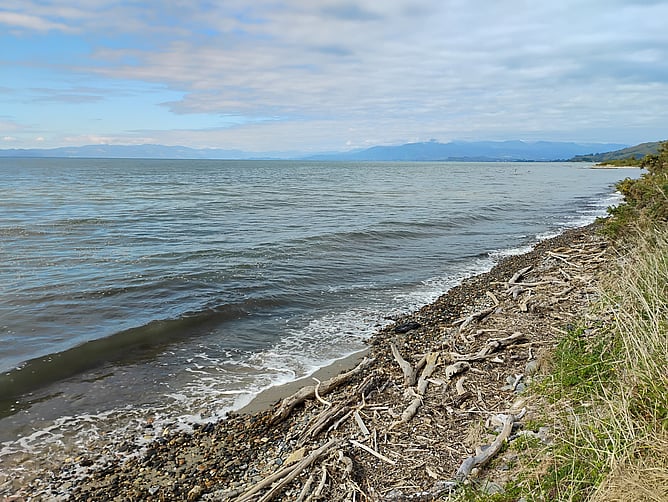
Another option is to try to get yourself a view of a blue space. Other research Berman mentions in Nature and the Mind was conducted right here in Wellington, by Daniel Nutsford. It found that the more 'blue space' - sea, or a lake - that people can see from their homes, the better their mental health, even when controlling for other factors, like income. I can’t see why that wouldn’t also work from your office window?
What else can I do to interact with nature and reduce stress at work?
If you have autonomy over how you work, this suggestion is a good one that gets you fresh air, maybe the sounds of nature and perhaps a view of some trees - all while brainstorming whatever work task or project you'd usually discuss in a meeting room or on a Teams call. It's called taking a ‘walking meeting’.
In research at Stanford University, Marily Oppezzo and Daniel Schwartz found that walking while working on some kind of creative task is good for your divergent thinking. That is, it makes you more creative! That means that taking a walking meeting is a completely defensible trip away from your desk and out of the office. You'll get a little interaction with nature, while performing a work task better than you would inside.
But it’s something extra to fit in, isn’t it?
Well, the good thing is that, in our mentally scattered and stressed-out states, none of these suggestions for how to inject a little interaction with nature in your work day takes much added effort. And the simulated nature options are doable even if you work from home in a high-rise apartment block.
In any case, the small amount of effort and forethought they might require is outweighed by the energy, the clarity in thinking, the generosity in communicating that comes from them, and that means being less stressed at and from work. Yay.
So, is this making you think?
What could you do today, or tomorrow, to interact with nature and get a cognitive boost? Could you even make it a regular thing?