Last week, a friend and I were exchanging WhatsApps about my recent long weekend holiday away. I had sent 10 or 11 shots of one of the most beautiful parts of the country: trails through virgin New Zealand bush, the jewel-like clarity and sparkle of the water in a natural spring, a vast expanse of dune and sea at a picturesque beach. And all of that was stunning.
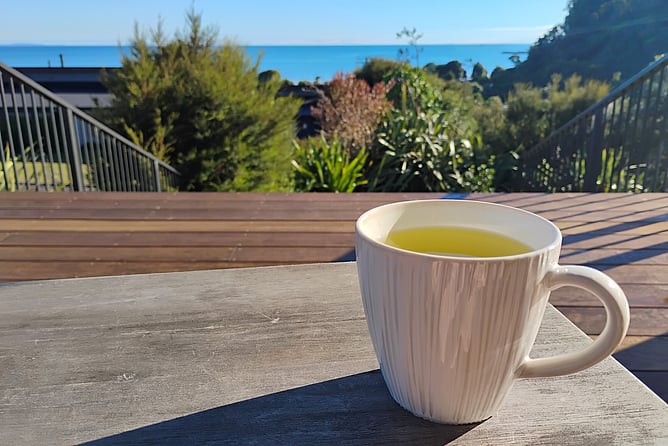
Then I sent a picture taken on the deck on a sunny morning, with my green tea on a table in front of me, and a view of the sea in the distance. All four of my holiday housemates were out at the time, rock-climbing some local sea cliffs. So what the picture didn’t capture was the immense quiet, save the bees buzzing, the birds cheeping, and the wind blowing through the flax leaves. I had the sudden realisation that that was my favourite bit of the whole trip, and that perhaps rather than a spectacular location, all I needed for a good holiday was an absence of people! (At least for a couple of hours at a time…)
So, what does that tell us?
For me, at least, there shouldn’t have been any sudden realisation that I need time by myself. I’ve known that since I was 19, when I discovered a psychology book in the university library and had a quiet ‘ohhh’ moment. But maybe it was a reminder that I too can forget the significance of my own personal wiring, in a country – like many, perhaps even most, Western countries – where extraversion is the dominant and even expected way of showing up.
You may already know the difference between introversion and extraversion, but let me do a quick 101 before we continue, just in case.
Earlier, when I said extraversion was the dominant or expected way of showing up in New Zealand and other Western countries, what I should have said more specifically was, extraversion is the dominant way in our culture of directing and recharging your energy. That is, extraversion – and introversion! – are really about what activities people prefer to give their energy to, what might deplete their energy, and how they get their energy back when it’s low. Introverts tend to be more comfortable spending time in their own heads, recharge in solitude, and find social and more stimulating environments draining. Extroverts, on the other hand, are energized by social and more stimulating contexts, and may find periods on their own uncomfortable – or, less fun, at least!
I am guilty – as a proud introvert – of making extroversion and introversion into a ‘you-either-are-or-you’re-not’ kind of thing. But psychologists now believe these aspects of personality, and indeed people, sit on a continuum. That means you can be introverted or extroverted to varying extents, and a mix of the two, perhaps depending on the context. There is even a term now – ambivert – that describes people who operate equally well in both introverted and extraverted ways.
Perhaps you already know you’re one or the other, or an ambivert, or ‘on the fence’. No matter which, it’s worthwhile thinking about how it impacts our experience of work and of our workplace (because you know, I’ll always bring it back to work sooner or later!). Whether you’re someone who’s currently finding work a grind or a bit stressful, or just wanting to know if they can find an extra way to boost their own performance, there may be tweaks you can make.
For me, before I started working for myself and from my desk at home, I used to find open-plan workplaces and the constant ambient noise they bring put a serious dampener on my ability to think clearly, concentrate, and make progress with my work. But I know people who find open-plan workplaces energising and motivating. Back-to-back meetings remain a really effective way for me to speed up my battery depletion, but for others, that scenario makes work into one big party. Similarly, all-day training workshops or other multi-hour marathons might get me reaching for paracetamol, but I’ve seen people who are fizzing with energy when these are over.
Thankfully, lots of workplaces have invested in educating workers to understand the nature of their personalities as they pertain to work, and particularly what that means for how we should interact with others more effectively (and respectfully). I remember one such training session where the facilitator asked us to form a line based on our introversion/extroversion score on an assessment. So I moved to the extreme introverted end, and was surprised and delighted to find I had some company!
But even if you have had training or are already pretty self-aware, it can be difficult in modern workplaces not to get carried away by the sea of urgent and unpredicted demands, the ‘busywork’ that we can fall into when we use technology so much to communicate, and the pressure to be constantly available and connected. This almost certainly contributes to the statistics coming through about the significant percentage of workers who report experiencing stress at work most or all of the time.
For those who, like me, happen to fit among other introverts, you’ve probably already worked out ways to take the edge off the more draining aspects of your work and work environment out of sheer necessity. For survival, even. But what about ways you can actually supercharge your work contributions in a way that works for you? Some ideas follow, and they may be more relevant to knowledge workers than those in other sectors, but still. Take from them what makes sense to you and leave the rest!
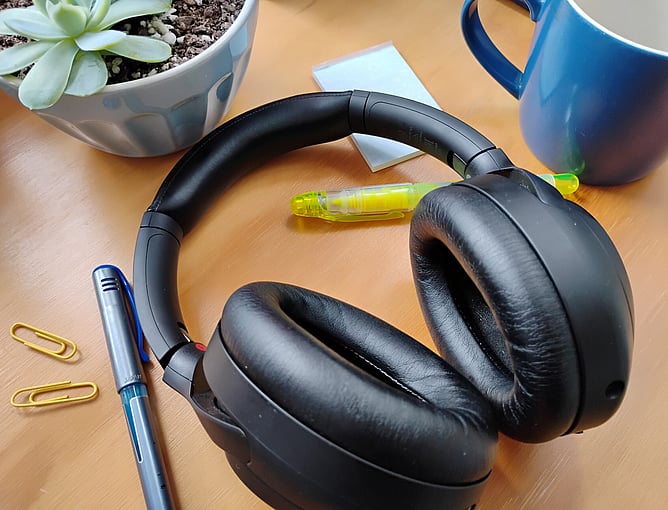
Suggestion #1. As well as donning your noise-cancelling headphones (I joined the wearers of headphones three years ago and it’s one of my best ever investments), would you consider making yourself radically unreachable for an hour each work day? If you close your email app down, turn off all notifications, and switch your phone to Do Not Disturb, you get yourself a beautiful expanse of time completely uninterrupted by texts, WhatsApps, emails, Teams messages and so on. This allows you to move from busyness into a ‘deep work’ mode, so you can think with real clarity and get into a flow state to power forward on any significant task. Chris Bailey is really big on this and does a deep dive on identifying and preventing distractions in his book Hyperfocus.
Suggestion #2 is small but mighty, and I wish I’d thought of it myself (but I didn’t – so my thanks to Rick Pastoor and his book Grip). You know all those internal messages that ping between colleagues every day in your office, each one representing an interruption to your mental flow at best and an increase in workload and overwhelm at worst? Quite a few of them could be avoided if we aimed for more ‘synchronicity’ (at the same time-ness) in our ‘asynchronous’ (split up across time) communication. For example, if you’re setting up a ‘quick chat’ with someone, instead of exchanging ten messages to cover off all the details, why not include as much information up front as possible? Something like: “Hi Anna, could we catch up briefly in person to discuss the progress report data please? It looks like you’re free on Tuesday morning. Does 10.30-10.45am work for you at the café downstairs? I'm also free at 2pm on Wednesday if that works better.” That’s potentially just one outgoing message, and just one interruption when a reply comes back!
Suggestion #3: an idea for reaping maximum benefit when it comes to team brainstorming. It’s an idea that can shorten meetings and make them higher value – which is good for introverts, but also everybody else! It’s an approach to brainstorming meetings called brainwriting which is a bit different to the norm. Each team member brainstorms on their own in writing before the group comes together, and then once in the same room (or Teams call) they pool all the suggestions and consider them as a group. Professor Leigh Thompson, from the Northwestern University School of Management, reported research in the Harvard Business Review that in a 6-person meeting, usually just two people do the talking for 60% of the time. As a result, quieter team members tend to disengage and withdraw, and the ideas that are progressed aren’t necessarily the best ones. But by taking a brainwriting approach, you and other introverts have the opportunity to contribute in a way that takes less energy and makes better use of the ‘deep’ thinking you’re good at.
We all have strengths to offer in the workplace – whether you’re an introvert, an ambivert or an extravert. The more we can find ways and have the space to work in tune with our innate preferences and strengths – our wiring – the easier the work will feel and the more satisfied we’ll be. It makes sense, right? Otherwise, work feels like an uphill battle. For me, in the type of work I do, it really helps to start the day quietly, with a pot of green tea and an absence of people noise. What’s your ideal set-up?