I had a job a while back that stretched my understanding of what ‘busy’ could look like.
I led an important piece of work, which, when it landed on my desk was already behind schedule, in a newly set-up team in a chaotic organisation. But I had recently started in the role and wanted to prove my mettle. I had a couple of colleagues who were feeding several hours each into the project each week, for which I was incredibly grateful, but which also added a ‘coordination overhead’. The diverse data that underpinned the project was either not available, not ready, or not validated, and the project deadlines were externally set (in stone). I was running a calendar in which each half hour slot was stacked sideways like a bar chart with multiple meetings or tasks, and if I looked at my inbox at certain times of the day, I could actually watch emails being delivered in real-time. I was overwhelmed, both feeling drained and hyper-vigilant, with little I could do about it, except to keep on ‘keeping on’.
I don’t take any consolation at all from the fact that my experience is just one of thousands. Maybe even millions.
Gallup reported in its 2025 State of the Global Workplace report that 49% of respondents in Australia and New Zealand had experienced stress at work during the previous day. And, the New Zealand public service census 2025 reported that 49% of public servant respondents perceived work volumes prevent them and their team from performing at their best to a great or very great extent. Forty-four percent of them said they had experienced work stress often or always during the previous 12 months.
It's not much of an endorsement of our workplaces, is it? And I suspect many people feel resigned to it, because it doesn’t feel as if workers have the power to change the situation. Big workloads, frequent structural change, and the constant distractions provided by our laptops and phones are ‘situation normal’ in most workplaces these days.
But as someone focused on helping professionals make more progress at work, with less stress, I’m interested in how we can tackle this overwhelm at work.
So I was happy to read that Nele Dael and her team, from the International Institute of Management Development, Lausanne and the University of Lausanne, suggest there are things that workers can do. Their research, published last September, did a ‘deep dive’ into the state of being overwhelmed by unpacking the lived experiences of employees. Their findings might surprise you.
Their qualitative study invited responses to a bunch of questions about experiences of being overwhelmed from 94 participants, aged 20-65, from various different industries. They were asked to describe any past experience in which they were overwhelmed, what that term meant to them, what thoughts and feelings they had at the time, and how they reacted to the situation.
From participants’ responses, the researchers were able to build a more precise definition of being overwhelmed than had been done before: that ‘being overwhelmed’ is the tipping point in the stress process in which a person switches from coping to no longer coping. (It makes me think of one of those massive water buckets at kids’ playground splash pads, which can take being filled with water and more water, up to a point, and then suddenly, tip over – soaking any person underneath.)
But importantly, that it’s also a phenomenon marked by a host of emotional, cognitive and physical effects: negative feelings like frustration and inadequacy, feeling ‘on alert’ and yet extremely tired, wanting to express yourself in some way (crying… shouting…) but pushing these feelings down, and mentally freezing up or wanting to remove yourself from the situation.
(I wonder what the results would be if someone surveyed workers on how many had ever gone to the bathroom for a quiet, private cry?)
It's no surprise to me, at least, that 60% of the research participants cited a work situation or workplace relationship issue as having triggered their state of being overwhelmed. Work is often a challenging environment to be in these days. Participants talked about having a high workload, low autonomy in doing their work, pressure from stakeholders, like their manager, or a client, organisational politics, interpersonal conflict and factors such as understaffing, as specific overwhelm triggers. One participant described being overwhelmed as feeling like they had too many tabs open in their brain. (Nailed it.)
As someone who is very practically oriented, the part of the article that grabbed me was what worked – and didn’t – in how to counter the overwhelm experience.
My go-to is always to get a fresh piece of paper, and spend 15 minutes writing down every task I can find in my brain and elsewhere, so I have a complete picture in front of me and can then build a schedule to work through it all. You’ll also find this approach suggested in books such Grip by Rick Pastoor, and I think it works for a lot of people. So I was surprised that in the research of Dael and her team, participants felt the problem-solving and planning approach was insufficient and unsustainable. (I’m now going introspective, re-assessing how well it’s really worked for me…)
Instead, the most common response to being overwhelmed, mentioned by 50% of participants, was engaging in one or another type of ‘resource seeking’ activity. For example, gaining social support (asking a manager for help), or investing time in activities that restore energy and calmness – resting, journaling, spending time in nature, physical exercise, or meditation. And participants rated these as more effective. (Note to self…)

Before we continue, I realise there’s a risk in reporting these research findings. You might think the message is – my message is – go and calm yourself down and all will be well. But it doesn’t work like that, does it. If your organisation is, like my old organisation was, stuck in the restructure groove, or is cost-cutting in other ways, or is on the receiving end of particularly high levels of public scrutiny for some reason, that stuff is all still going to be there when you come back.
And, while I think that organisations and leaders can and should do more to protect employees from the negative effects of those sorts of large-scale challenges above, and to promote and role-model healthy working, how you make sense of your work environment and what helps you recover when you’re stressed isn’t the same as the next person – and only you know what that is. So, employees are best-placed to go after what they need.
Sisters Emily and Amelia Nagoski, authors of Burnout: Solve Your Stress Cycle, offer a concept based on their research that’s relevant to this discussion. It’s that we need to make a distinction between the ‘stressor’ (the situation or person) that’s triggering our stress, and the ‘stress’ itself. Because, what fixes the stressful situation (or person) is not the same as what fixes your physiological stress response – your ‘stressed out’ feelings.
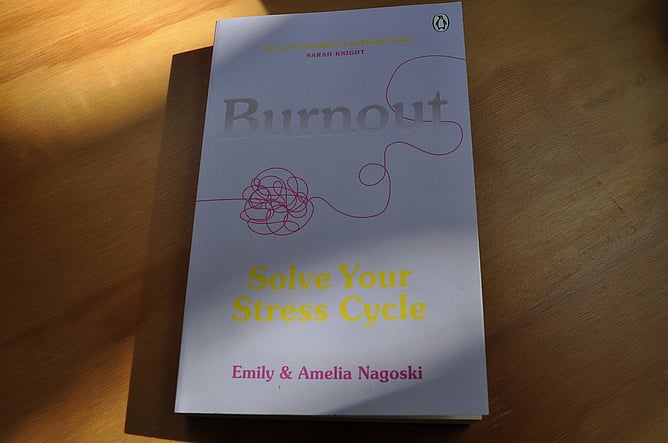
That means – and this is a good news story – that you can deal with the stress you feel, and feel better, even if you can’t deal with the situation. And this brings us back to the sorts of activities that restore energy and bring calm mentioned by Dael and her team’s study participants: physical exercise, breathing, social interaction... And the Nagoskis suggest we should be doing things like this every day, because we experience stress every day!
So. Action stations. If where you work there are difficult workplace politics, challenging stakeholders piling on pressure, or simply too few people to make the project timeline seem remotely doable, what small thing could you do today to tip the scales away from ‘overwhelm’ and back towards ‘coping’?