Have you heard the term ‘time anxiety’? You might have. I might just be late to the party – it was new for me!
A book written by Chris Guillebeau, published last year, Time Anxiety discusses that not-at-all-new feeling many of us have from time to time that there isn’t enough time to do all we need. It also refers to the feeling we might have, that while we’ve already done quite a bit of living, time’s running out to be and do and achieve all we dreamed of.
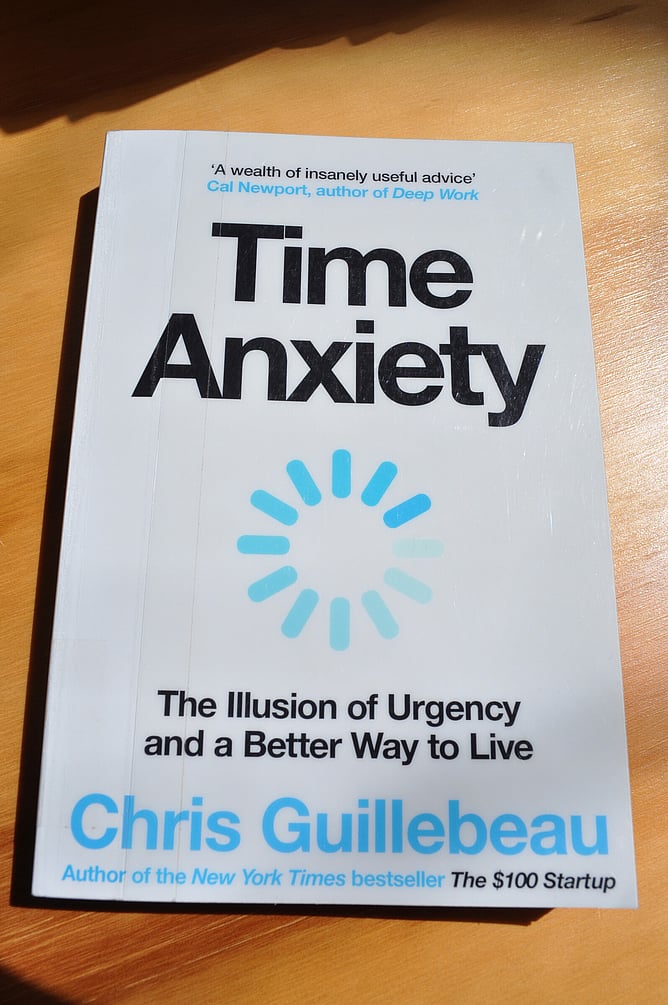
As someone who’s setting up a business, with the myriad admin tasks and research and conversations with fully-fledged businesspeople that requires, I would say I have some level of time anxiety most of the time! But it’s certainly not a phenomenon experienced solely by fledgling business owners – most of the people I’ve talked to about this book say the idea rings true.
Time anxiety’s not a scientific term though, and this isn’t a ‘science-help’ book tied closely to research evidence. Time anxiety is a term Chris came up with to encapsulate those feelings of worry about time in the short-term – and over the longer term, time’s passing.
I was slightly concerned this would be a book that would urge me to do all sorts of extra things, but as Chris makes clear in the introduction, this is not another book about productivity. Or rather, while increased productivity might be a secondary effect or side benefit of reducing time anxiety, it’s not his main goal. His focus is more on helping readers to overcome their time scarcity worry – to help them “feel better and worry less”.
In fact, if I had to summarise it in a nutshell, Time Anxiety is more a book about working less. Less on the things that are less important, leaving more time for the things that matter, and being gentle and forgiving of yourself as you go along. Chris writes – and I need to stick this on a Post-It next to my monitor – “One way or another, start resisting the expectation that your attention span is up for grabs. It shouldn’t be – it belongs to you, after all.”
The causes of time anxiety are the focus in the early chapters. Chris sees these (from his own experience and research) as including the following. The fight-or-flight mode we experience as a response to any task deluge. Cognitive distortions, including filtering towards the negative and catastrophizing. Sticking doggedly to self-imposed ‘time rules’, like, ‘I must finish everything I start’. And the chapter on ‘time blindness’ might be illuminating.
I think I have at least one foot in the time-blind camp, I’m willing to admit. One of my friends once called me ‘the most disciplined person I know’. But as well as wanting to go out and do things and see people, I also like (need) a tidy house. Meaning, there are very few weeks that go past where I don’t end up running to catch the bus because I decided to fit in one more “quick” domestic task! (If I didn’t know the real reason there are constantly inside-out socks on the floor, I’d think there was some very specific type of gravity making them land there, instead of in the dirty laundry pile.)
So, what can you do, if this is sounding familiar for you, in full or in part?
The book is packed with actionable suggestions (but not to the extent of being overwhelming). Not only are there time anxiety-combatting techniques interwoven with the stories and very digestible explanatory text inside each chapter. Each chapter is followed by a Practice section that focuses on one key action you could experiment with. And it’s all conveyed in an easy-going style, laced with dry humour. Case in point, the title of chapter 12: “Be right back, I’m just going to disappear and never return.” A sentiment that I have definitely had more than once in my working life.
Some of Chris’ suggestions will challenge or even threaten those of us who hold perfectionism close to our hearts, such as ‘Do things poorly’, but he means this in the sense of ‘Done is better than perfect’. I shared this part with a friend who texted back, “That’s a life’s work for me.”
But most suggestions had me nodding for their sensible-ness, at least ‘sensible’ the way I see it. I’ve decided to do my best to try: leaving an extra 15 minutes early before I need to be somewhere, pausing before I start a big task to decide what ‘Done’ looks like for the day, and catching myself getting cognitively distorted and catastrophising when my day gets unplannedly frantic so I can pause to reframe. (Unplannedly isn’t a word, is it?... Bear with me, I make up words sometimes.)
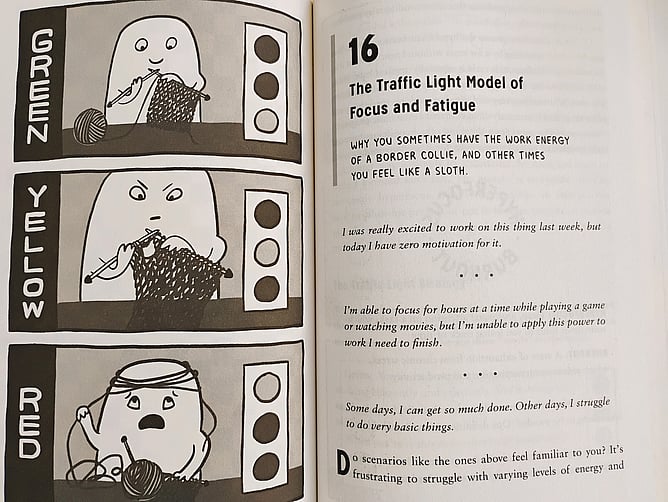
I also want to try and tune in more to my energy levels, and not try and bulldoze myself in the process of sticking rigidly to my plan for the day. Like a lot of people, I’m juggling work and a busy home life, and my energy needs to stretch across multiple work (and home) streams. Chapter 16 of the book is entitled “The Traffic Light Model of Focus and Fatigue” and talks about this issue, so succinctly described in the chapter subtitle as: “Why you sometimes have the work energy of a border collie, and other times you feel like a sloth.”
In sum, it’s a book I’m definitely recommending to others. It puts a lot of the ‘human being’ back into being human at work, and, happily, is another book in the same category as Slow Productivity by Cal Newport, in which authors are arguing for different, more thoughtful ways of attaining ‘productivity’ – not simply doing more. In a number of chapters, it also covers ground from the research evidence, like the University of Washington’s Sophie Leroy, and her research on ‘attention residue’ when we try and switch constantly between work tasks. But it isn’t a book laden with research citations, as in some others, which makes it super-readable.
In his chapter on email (“The Inbox of Shame”), Chris gives advice that provides a sense of the book’s overall message: “…admit your inability to become superhuman, freely acknowledge that your attempts to keep your communication up-to-date will always be futile – and get on with living, as best you can and in the way you’ve always wanted to.”